Edit mode — click any text to edit · Ctrl+S to save · E to exit
PKM · LLM-Wiki · Personal System Design

My Personal LLM-Powered Knowledge System

Two vaults. Two patterns. One compounding loop.
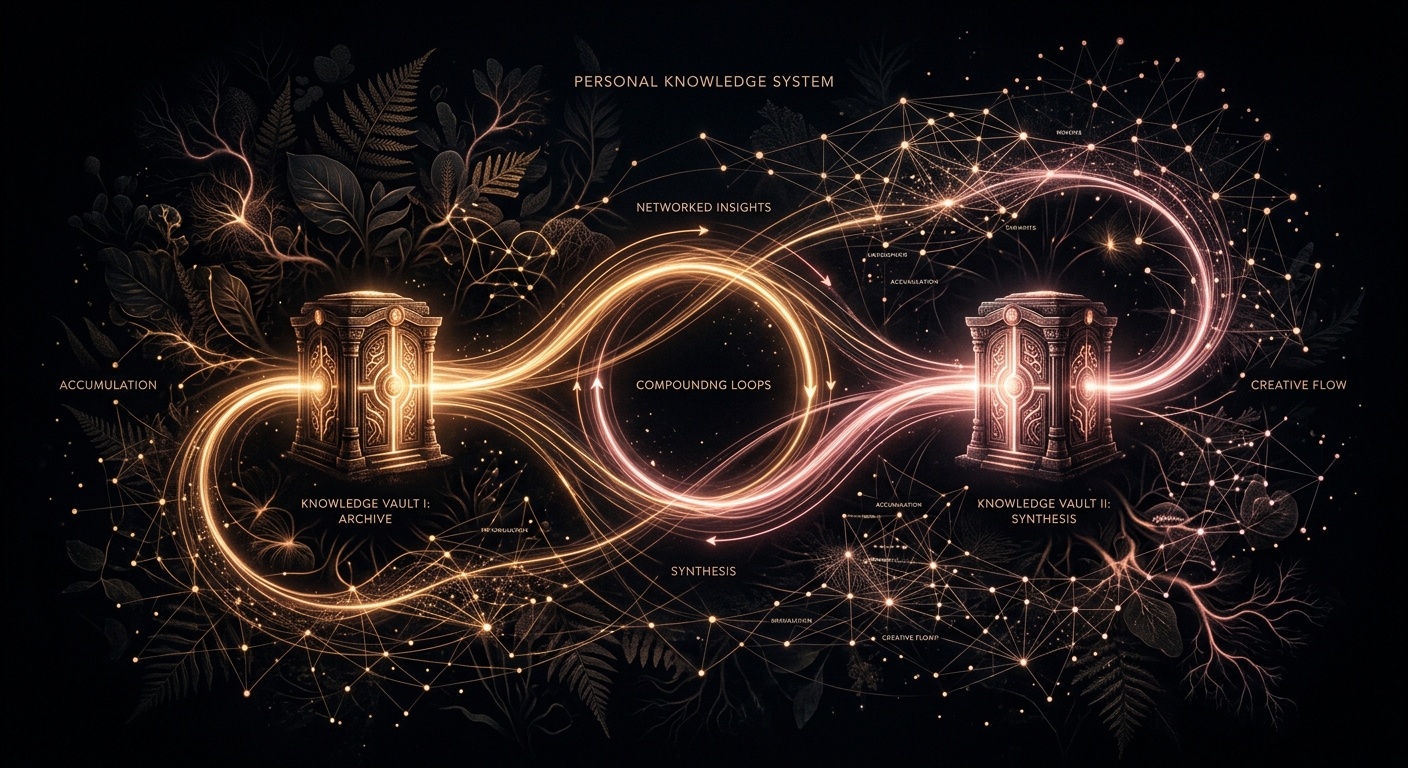
2 Vaults 5 Primitives each Compounding
Two knowledge vaults connected by a compounding loop
01 / 12
The Problem

Traditional PKM fails in two ways

Symptom 1 Collecting everything → nothing compounds Pure RAG re-derives knowledge from scratch on every query. Nothing accumulates.
Symptom 2 Writing inside your notes app → lifecycle hell Drafts and wiki pages have opposite lifecycles. Forcing them into one layer creates friction.
Root Cause Most tools try to solve both in one place That's the mistake. The two activities have fundamentally different shapes.
02 / 12
The Insight

Two activities, two fundamentally different shapes

Accumulation

Convergent

Compress, synthesize, never "done." Each source patches existing pages. The wiki grows richer over time. Artifacts: wiki pages. Audience: LLM retrieval.

Generation

Divergent → Convergent

Expand a seed, then shape it into a publishable artifact. Has a publish moment. Artifacts: drafts. Audience: human readers.

03 / 12
The Solution

Two vaults — one purpose each

Vault 1 — Knowledge

LLM-wiki pattern

PurposeAccumulate, synthesize, compound
ArtifactsWiki pages — never "done"
MutabilityLLM freely rewrites; sources frozen
AudienceLLM retrieval
Vault 2 — Writing

LLM-writing pattern

PurposeDraft, revise, publish
ArtifactsDrafts — have a publish moment
MutabilityLLM edits until publish; briefs frozen
AudienceHuman readers
04 / 12
Vault 1 — Knowledge

The LLM-wiki pattern

I
Raw sources — immutable
Clippings, watchlist, daily notes. LLM reads but never rewrites. The permanent record of what entered the system.
II
Wiki — LLM-owned synthesis
Freely rewritten, cross-linked, always evolving. Topic folders as retrieval axis. Lifecycle lives in frontmatter, not folder paths.
III
Schema — co-evolved
CLAUDE.md defines conventions. index.md is the content catalog — always read first. log.md is the append-only timeline.

Key insight: LLMs don't get bored maintaining a wiki. Humans do.

05 / 12
Vault 1 — Primitives

Five slash commands, nothing more

/ingest
New source enters. Patch existing wiki pages autonomously; propose new ones with user consent.
/query
Retrieve and synthesize. Good answers become new wiki pages — explorations compound.
/lint
Health check: dead links, orphaned notes, stub rot, stale watchlist, contradictions.
/watch
Pull external feeds — GitHub releases, Twitter — and surface changes worth ingesting.
/ideas
Capture fleeting fragments in daily notes before they disappear.
06 / 12
Vault 2 — Writing

The LLM-writing pattern

I
Briefs — immutable seeds
The frozen original intent: angle, audience, key claim. Never rewritten. Play the same role as raw sources in the knowledge vault.
II
Drafts — LLM-owned
Freely written, restructured, edited until publish. Unlike wiki pages, drafts end — they have a publish moment.
III
Schema — same pattern
CLAUDE.md, index.md (always read first), log.md (append-only). Identical structural discipline, different operational content.
07 / 12
Vault 2 — Primitives

Five slash commands — same discipline

/brief
Capture the seed of a new piece: angle, audience, key claim, motivation. Always autonomous.
/draft
Start or continue developing a brief into a full draft. LLM writes, restructures, edits freely.
/review
Health check: clarity gaps, stale drafts over 30 days, briefs that never became drafts.
/publish
Close the loop: archive draft, log it, flag non-obvious claims for knowledge vault ingest.
/ideas
Same as knowledge vault — fleeting fragments that may become briefs.
08 / 12
The System

The compounding loop

Knowledge Vault /query — what do I know about X?
research flows down
Writing Vault /draft → revise → /publish
new claims flow back
Knowledge Vault /ingest — wiki grows from writing
09 / 12
Why It Works

Single-purpose by design

01
No lifecycle collision
Drafts don't contaminate the knowledge graph. Wiki pages don't get publish-anxiety. Each vault has one job.
02
LLM context stays clean
Each vault has its own CLAUDE.md. The LLM knows exactly what it's doing and why — no ambiguous instructions.
03
Loop actually closes
Writing produces knowledge. Knowledge enables writing. The /publish → /ingest step turns output into input.
04
Karpathy's principle holds
Persistent compounding artifact — applied to both accumulation AND generation. The discipline scales.
10 / 12
Setup

Two vaults, same structural discipline

Knowledge Vault

LLM-wiki pattern

CLAUDE.md — three-layer model + 5 primitives
index.md — content catalog, always read first
log.md — append-only timeline
sources/ — immutable raw inputs
wiki/ — LLM-owned synthesis by topic
Writing Vault

LLM-writing pattern

CLAUDE.md — adapted three-layer model + 5 primitives
index.md — active drafts + recent published
log.md — briefs, drafts, publishes
briefs/ — immutable seeds
drafts/ + published/ — lifecycle folders
11 / 12
The Takeaway
"The vault stays a single-purpose knowledge graph.
Writing is a consumer of it, not a resident in it.
The loop compounds without the complexity bloat."
Start with the knowledge vault.
Add the writing vault when you have something to publish.
Let them compound.
12 / 12